
Citizen Sensing
David and GolAIth
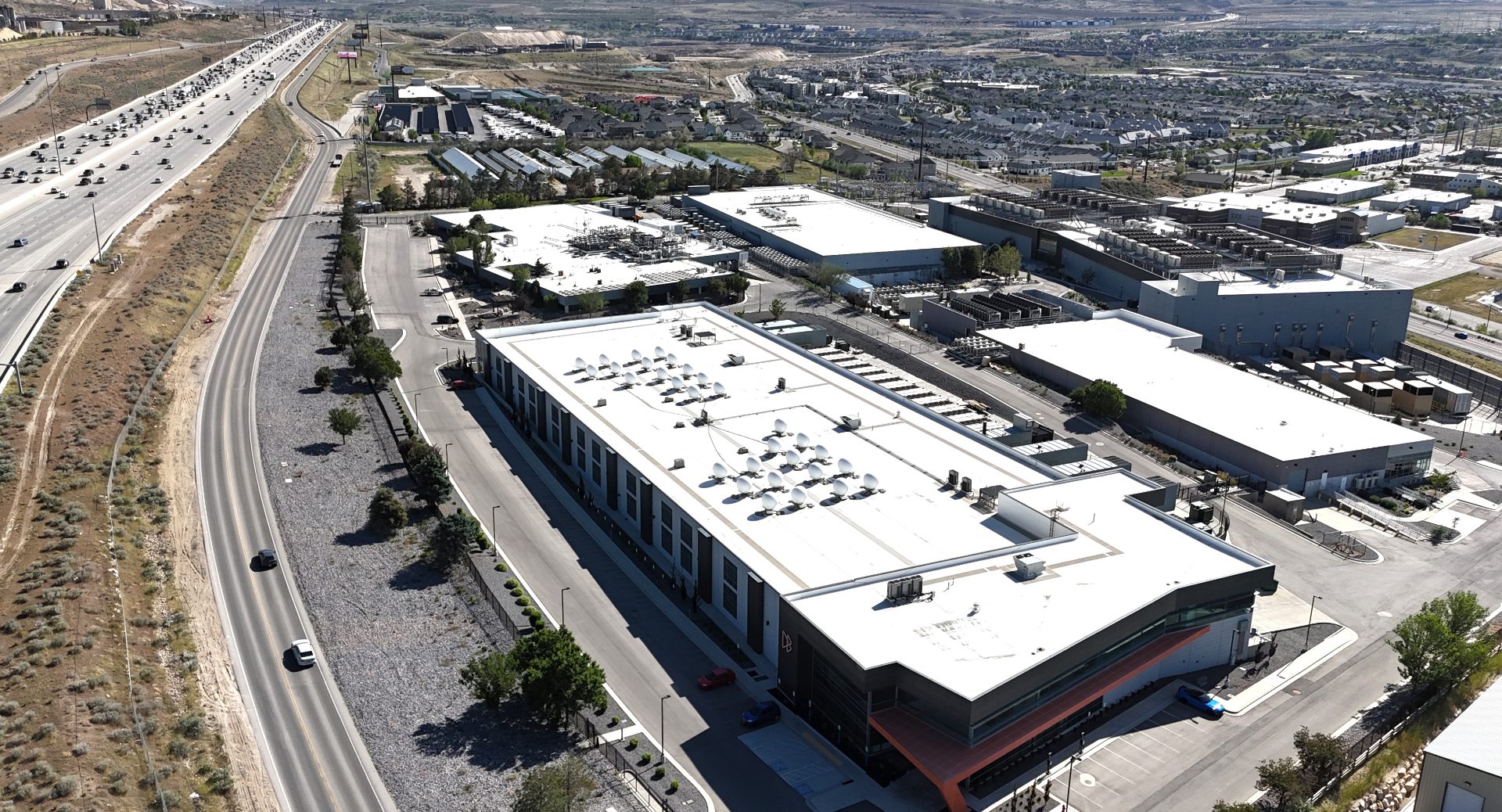
Photo of the Bluffdale (UT) 45 MW campus by Rob Ricci
Global expansion of AI is forcing some of us to come to terms with the physical realities of what has been branded “the cloud” ever since Amazon launched its web services back in 2006. Across the world, data centers are being constructed at an unprecedented pace, transforming hundreds of acres of farmland, former industrial sites, and residential perimeters into sprawling, low-slung concrete facilities housing thousands of energy-intensive servers.
This rapid build-out has triggered an unexpected grassroots backlash. US polling indicates that approximately 70 percent of Americans oppose the construction of AI data centers near their communities. A cascade of local environmental and economic disruptions seems to be the cause: continuous low-frequency acoustic noise from cooling arrays, massive evaporative water depletion, spiking electricity rates, localized waste heat plumes, or toxic air emissions from large banks of backup diesel generators.
Alongside these burdens, there is a systemic withdrawal in regulatory oversight. The US has seen proposals to eliminate mandatory public notice and 30-day public comment windows for minor source air pollution permits. Municipal governments conduct negotiations under non-disclosure agreements or grant tax increment financing carve-outs, leaving residents blindsided when data center backup power arrays arrive overnight.
In a way, this situation is reminiscent of the Fukushima disaster which saw local residents use handheld sensors to measure radiation independently. It saw the birth of Safecast and led to the creation of the largest independent open dataset of background radiation in history, establishing a new model for grassroots environmental monitoring I like to refer to as citizen sensing. Can this same mindset counter the information deficit in AI’s physical footprint? For over three decades, volunteer water monitoring under the US Clean Water Act has demonstrated how non-governmental data collection can fill agency data gaps, influence statutory impairment listings, and drive enforcement action. Applying these established legal, technical, and legitimization frameworks to data center expansion offers a strategic playbook for communities seeking to hold tech hyperscalers, utility providers, and regulatory agencies accountable.
Local Externalities
According to data compiled by the International Energy Agency and reported by Our World in Data, global data centers consumed approximately 485 terawatt-hours (TWh) of electricity in 2025. That is roughly 1.5% of total worldwide electricity generation, with AI accounting for approximately 0.5% or 155 TWh. While global percentages appear modest, electricity demand is highly concentrated to specific grid corridors. Ireland (where data centers consume over 20% of national power) is the cautionary tale, but the same saturation is unfolding in Germany, where Frankfurt am Main data centers claim over 20% of municipal electricity, and in France, where subsea cable landings in Marseille collide with Mediterranean drought and water rationing.
Next comes waste heat. Peer-reviewed field research by David J. Sailor et al. at Arizona State University highlights data center waste heat rejection as microclimate warming that drives home air conditioning, triggering a compounding feedback loop of localized energy demand and urban heat island stress during extended summers. Consider the CyrusOne colocation campus in Chandler (AZ) comprising 169 MW of critical capacity across eight facilities. It emits heat equivalent to 180,000 households across a 34 ha site.
To maintain 5-nines operational uptime, hyperscaler facilities install massive backup power reserves consisting of dozens of industrial diesel generators. During routine testing and utility grid outages, these generators emit significant quantities of fine particulate matter (PM2.5), nitrogen oxides (NOx), volatile organic compounds (VOCs), and hazardous air pollutants such as formaldehyde.
Accelerating Build-out, Reducing Review
Despite mounting evidence of impacts, authorities increasingly move to streamline industrial permitting by curtailing public oversight. In the United States, proposed federal EPA regulatory revisions seek to eliminate mandatory requirements for state agencies to publicize and solicit public comments on “minor source” air pollution permit applications. Another proposal would permit developers to start physical site construction before air quality permits receive formal administrative approval.
These rollbacks coincide with practices such as signing non-disclosure agreements with developers, redacting utility water and power consumption metrics in public record releases, and bypassing municipal planning commissions.
Not too different on this side of the Atlantic. While the EU has the Aarhus Convention guaranteeing access to environmental data, tech hyperscalers frequently exploit municipal commercial-confidentiality loopholes to circumvent early public scrutiny.
In her extensive field reporting across Midwestern data center battlegrounds in Wisconsin and Michigan, political analyst Jasmin Sun observes that community backlash extends beyond NIMBYism (“Not In My Backyard”). Residents perceive the build-out as a top-down imposition of corporate power that strips everyday people of their democratic voice.
This blog covers a range of examples where citizens leverage civic monitoring to address local issues and it seems to me that data center build-out makes for yet another application of citizen sensing.
Citizen Science and the Clean Water Act
The Clean Water Act (CWA) is an ideal case study for how a civic monitoring response to data center expansion could work. As documented in foundational studies by George Wyeth et al. at the Environmental Law Institute, water quality monitoring represents the most successful integration of citizen-generated data into official regulatory decision-making in the United States, codified by federal legislation such as the Crowdsourcing and Citizen Science Act of 2016 and backed by the National Advisory Council for Environmental Policy and Technology advisory frameworks.
- Under the CWA, state environmental agencies are legally mandated to assemble and evaluate all “existing and readily available water quality-related data and information” when identifying impaired water bodies and establishing maximum amounts of a specific pollutant (aka total maximum daily loads).
- To bridge the gap between volunteer data collection and formal agency uptake, state water programs established structured Quality Assurance Project Plans and transparent 3-tier data quality frameworks (educational, screening, and regulatory).
The CWA has already repeatedly triggered formal enforcement investigations. For example, in Pennsylvania back in 2010, volunteer monitoring detected anomalous water quality shifts that uncovered a major Marcellus Shale fracking blowout.
The Clean Air Act
Unlike the CWA, the Clean Air Act (CAA) does not contain explicit statutory mandates requiring agencies to evaluate all available third-party data. Here, US Federal courts have consistently affirmed agency discretion to reject private air sensor data for formal regulatory classifications.
This barrier became evident in Houston (TX) where Air Alliance Houston (AAH) deployed 5 mid-cost particulate monitors in the low-income neighborhood of Galena Park. Although AAH’s network captured localized PM2.5 exceedances that the state’s single regional monitoring station missed, EPA rejected the data for formal attainment modeling because the sensors were not approved Federal Reference Methods. There are other cases such as Mississippi Commission on Environmental Quality v EPA and Sierra Club v Tennessee Valley Authority that show that the CAA “Credible Evidence Rule” does not allow citizens to use unvalidated, non-reference monitoring in lawsuits.
The EPA Office of Air and Radiation had issued a memo back in 2020 on Air Sensors Policy by Anne Idsal Austin that may lead to some change. It states that while sensor data cannot alter formal National Ambient Air Quality Standards attainment statuses, it is highly valuable for non-regulatory applications e.g. identifying hotspots, optimizing official monitor placement, informing municipal planning. The policy memo was further enforced by EPA’s 2022 Vision and Principles for Participatory Science.
The EU Counterpart to CWA / CAA
The Pillar of Access to Information and Justice in Europe is the UNECE Aarhus Convetion. Unlike the US system where citizens often face “trade secret” and NDA redactions, Pillar 1 of the Aarhus Convention gives European citizens a guaranteed legal right to access environmental information held by public authorities without having to prove a specific legal interest.
Since May 2024, the EU Energy Efficiency Directive mandates that data centers with an installed capacity above 500 kW must publicly report their energy consumption, water footprints, and waste heat reuse into a European-wide database.
Germany’s Energy Efficiency Act (Energieeffizienzgesetz or EnEfG in short) legally obliges new data centers to reuse a minimum percentage of waste heat (starting at 10% and scaling up to 20%), an area ripe for thermal monitoring by citizen scientists equipped with thermal traverses and IR cameras.
Possible Paths Forward
The California Assembly Bill 617 creates a legal blueprint for neighborhood-scale environmental governance that overcomes CAA’s restrictions. It mandates that local air districts and community steering committees co-design dedicated community air monitoring networks and localized Community Emissions Reduction Plans in overburdened neighborhoods. Applying AB617 to data center hubs could allow host communities to establish hyper-local sensor networks, mandate continuous fence-line monitoring, and negotiate enforceable operational caps on backup generator testing and HVAC noise.
Citizen sensing has evolved from the days of Pachube and Safecast. Drawing on Anna Berti Suman’s taxonomy of 7 legitimization strategies, advocates can transform grassroots observations into legally defensible, policy-impactful evidence.
- Missing Knowledge: deploying handheld acoustic meters and mobile temperature sensors to map unmonitored noise and waste heat plumes
- Scientific Robustness: partnering with academic institutions, adhering to formal QAPPs, and co-locating low-cost sensors with official FRM monitors
- Complementary Knowledge: Building high-density spatial sensor grids that capture micro-scale neighborhood variations missed by regional air stations
- Social Impact and Crowd Action: Aggregating community reports on nationwide platforms (e.g. Erin Brockovich’s Issue Map)
- Data Democracy: Using transparent civic data to challenge corporate NDAs, secret TID tax deals, and democratic deficits in municipal zoning
- Law Enforcement: Submitting validated sensor data to trigger agency inspections and enforce CWA/CAA permit compliance and local decibel limits
- Environmental Justice: Asserting human rights to health, clean air, and public input to protect fence-line communities from cumulative industrial burdens
Operationalizing Citizen Sensing
Following the methodology established by Sailor et al., community members can equip vehicles or bicycles with aspirated, shielded Resistance Temperature Detectors and GPS loggers to conduct thermal traverses upwind and downwind of data center perimeters. Documenting 1 ℃ to 2.2 ℃ thermal plumes advecting into residential zones provides empirical proof of urban microclimate damage. Monitoring waste heat aligns with Germany’s EnEfG waste-heat reuse mandates.
Deploying calibrated sound level meters along public rights-of-way documents low-frequency HVAC and transformer noise exceeding municipal noise ordinances. Placing PM2.5 and NOx sensors near facility boundaries captures unpermitted generator testing spikes. Noise monitoring in dense European residential areas (e.g. Seine-Saint-Denis or Frankfurt’s mixed-use quarters) is particularly relevant where setback distances between data centers and apartment blocks are much narrower than in sprawling US business parks.
Submitting self-reported data to platforms like Erin Brockovich’s aggregates individual complaints into a national geospatial database, exposing systematic corporate patterns. Not her first rodeo, you may recall her story with PG&E…
In the United States, citizens collecting data near industrial sites are protected by constitutional law. In the 2015 case Western Watersheds Project v Michael, the Court of Appeals struck down Wyoming’s “data trespass” statute, establishing that gathering environmental resource data from public vantage points is protected creation of speech under the First Amendment. This precedent safeguards citizens photographing facility plumes or logging noise readings from public sidewalks and roads.
As stated in the list above, advocates must partner with university researchers, establish written QAPPs, document volunteer training, and present qualified witness testimony to validate sensor calibration.
Conclusion
By combining the legal rigor of CWA data integration with modern citizen sensing technologies and strategic legitimization claims, citizen science transforms from a passive educational tool into a powerful instrument of civic defense and mediation. The expansion of digital infrastructure should not come at the expense of community health, environmental justice, and democratic dignity.
 This material is licensed under CC BY 4.0