
Citizen Sensing
Proto Creek Watch
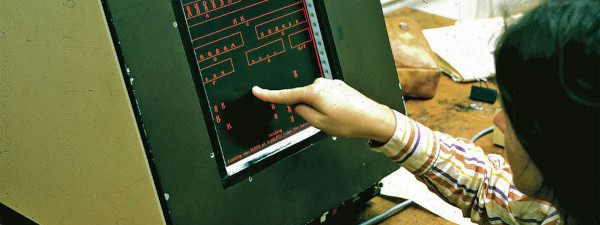
PLATO IV Terminal IEEE Spectrum
I am finally returning to this blog after reading the story of a time-sharing system known as PLATO that started in the late 50s at the Computer Systems Laboratory of the University of Illinois [1]. PLATO stands for Programmed Logic for Automatic Teaching Operations. The story of this system starts 2.5 years after the Sputnik launch and as the USA accelerated investments in STEM and opportunities to fund interesting scientific projects. I realize that this is another US-centric account, alongside Simulmatics and Community Memory, and that I should continue looking for stories in other parts of the world, like project Cybersyn in Chile… but let’s stick with PLATO for this one.
Immediate Feedback
CSL was originally a lab for classified projects working on radar systems for military use. Think of data processing units mounted on vessels to process radar signals from many aircraft and provide guidance about potential targets. Systems where feedback loops are essential.
The same principles of feedback would be applicable to teaching or automatic learning. A time-sharing system could be envisioned to process the signals sent by a student to a computer and respond immediately to provide immediate knowledge of results in Skinner’s terms. B. F. Skinner was the radical behaviorist who envisioned a teaching machine and actually built a first prototype in 1954 demonstrating the concepts of self-pacing and immediate feedback. The first architecture diagram was simple and focused initially on immediate feedback.
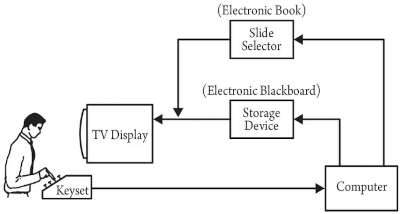
PLATO started as a pure education project on the hardware available at the time. The ILLIAC (Illinois Automatic Computer) is a vaccuum tube dinosaur of a computer with a main memory of 1K 40bit words with an additional 12800 words on a drum memory. At that time, cost of memory was $2 per bit. This would be a constraint for a teaching machine that had to have a graphical display. In order to work around this cost constraint on memory, the team wound up with a way to engineer a display based on gaseous plasma discharge at the intersection of wires forming a grid that effectively acts both as display as well as the memory of the content being displayed. The use of neon as gas is what gave the PLATO displays their orange glow. This idea would become the basis of the patent for plasma displays which funded the project for many years.
ILLIAC was not a time-sharing system and ultimately not suitable for PLATO’s ambitious program. The team switched to a CDC 1604 in 1962 which was a machine designed by Seymour Cray who would later start his own brand of supercomputers. Gone were the vacuum tubes. The 1604 is one of the first transistorized computers to be available commercially. Its memory consists of 32K 48bit words.
The culture at the CSL was very different than other similar labs across the US. High-school kids would be most welcome to join effort in developing the system.
Beyond Teaching Machines
The idea of scalability by the early seventies came with the CDC partnership and the possibility of supporting thousands of terminals powered by a set of inter-connected mainframes. While PLATO never reached the numbers Don Bitzer dreamt of, it supported several hundred terminals. Combine this with the open CSL culture and you get a rich ecosystem of applications in the early seventies that included chat rooms, instant messaging, e-mail, message boards, newspaper, multi-user games. All started by the high-school children attending the lab.
The author notes that the inter-personal computer revolution started at Chambana before microcomputers got their modems and users became interconnected… all in 1972, 1973. Yet, this story seems to have gone unnoticed for so long. PLATO coexisted with the personal computer for a few years. It wasn’t until 1978 that the personal computer community could access the first public BBS launched using an early Hayes modem. The PLATO folks on the other hand knew very well by then the meaning of interconnectedness.
Community Planning
PLATO would be used for all sorts of things. One story that I liked particularly from Brian’s book was the use of PLATO to involve citizens in community planning. A topic I have covered in another post.
In 1970, two graduate students of UI were looking to push PLATO beyond mere education. They decided to use it to raise awareness about Boneyard Creek. Today the river is a public amenity to the people of Champaign-Urbana but it was not always like that. A flood in 1979 would get things moving in terms of urban planning. But back in 1970 the creek was in poor shape. Its banks would be subject to all sorts of alterations including brick or concrete retaining walls, chain-link fences with barbed wire and make it unpleasant to the eye (and the nose).
The students figured they could create a TUTOR application called Creek that would be the first “non-lesson lesson” on PLATO and become an “Electronic Town Hall.” A report on Creek is still available online. The project ran between June 1970 and April 1971 and focused on the future of Boneyard Creek.
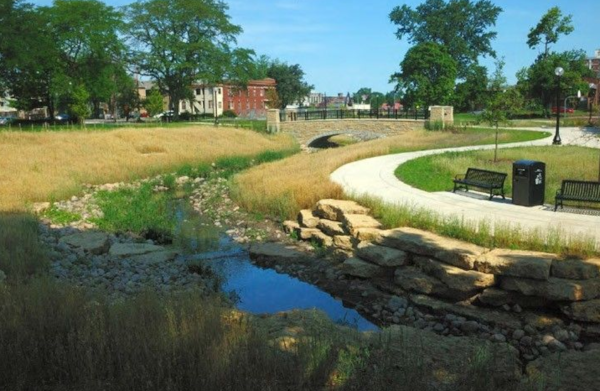
Boneyard Creek, Downtown Urbana, IL Andrew Dunham
Creek users viewed a structured sequence covering the history of the creek, current plans, alternatives (namely sheetpiling vs landscaping), and potential citizen actions. Interactive features included branching sequences i.e. optional paths, a dictionary of terms and comment mode. Data was collected through questions embedded in the program. The study report states 107 participants with the following key findings [2]:
- Participants were willing to engage with the program and found it useful for presenting concise, relevant, and factual information. Over 80% of participants felt this was a useful way to review community issues.
- While the majority of participants did not change their minds, 34% reported that the program did change their opinion. Significantly, of those who changed their minds, 60.6% had previously held no opinion on the issue.
- The most cited advantages were the ability for active participation (giving comments/answering questions), the use of branching sequences to control information flow, and the perception that the medium was more unbiased than traditional media.
- Approximately 33.2% felt the program was unbiased, but a significant portion noted a bias toward land improvement (landscaping) over sheetpiling. Primary criticisms included the inconvenient location of computer terminals and the fact that the technology currently reaches only a limited audience.
- There was high enthusiasm for the medium, with over 90% of participants expressing a desire to see more community issues (such as ecology, race relations, and education) presented on the PLATO system.
CERL (Computer-based Education Research Lab, the new name of CSL since 1965) considered Creek as a potential PR nightmare. Nevertheless Creek demonstrated early on the potential of software applications for citizen use.
New Medium
The use of PLATO to involve students, academic staff and citizens in monitoring their waterway felt like a proto Creek Watch. It resonated with other civic application of information technology covered on this blog. A first step towards deliberative online applications around environmental issues at a time personal computing was just starting and very much offline.
References
[1] The Friendly Orange Glow, Brian Dear, 2017, Pantheon
[2] CERL Report X-34, Valarie C. Lamont, July 1972
 This material is licensed under CC BY 4.0